Tag: oliveoil

  • Bringing People Together, One Table at a Time

    There’s a quiet kind of magic that happens when people gather around a table. Not a fancy table. Not a perfect one. Just a table—maybe a little crowded, maybe mismatched chairs, maybe a loaf of bread torn by hand instead of sliced neatly. The kind of table where stories spill as easily as olive oil and no one is counting minutes.

    Food has always been our oldest invitation.

    Before reservations and tasting menus, before trends and timelines, we gathered to eat because we needed one another. To share. To pause. To belong. A table was never just about nourishment—it was about connection. About listening. About leaning in.

    Olive oil, in particular, carries this tradition beautifully. It’s humble and generous. It doesn’t demand attention, but it rewards it. A drizzle on warm bread becomes an opening line. A splash in a salad becomes a conversation starter. A tasting becomes an excuse to slow down and notice something together.

    I see it every time people come into a tasting or a class. Strangers arrive politely distant, arms crossed, phones tucked close. Then a bottle is opened. Someone coughs at the peppery finish. Someone else laughs. “Is it supposed to do that?” And suddenly the room softens. Questions follow. Opinions form. Memories surface—of a grandmother’s kitchen, a trip to Italy, a meal that lingered longer than expected.

    That’s the moment people start to gather—not just physically, but emotionally.

    Bringing people together doesn’t require perfection. It requires intention. A willingness to open a door, pour a little something, and say, “Try this.” Food does the rest. It gives people permission to talk. To disagree kindly. To share something real.

    In a world that often feels rushed and divided, the act of gathering has become quietly radical. Sitting down together—without an agenda, without a screen between us—is a small rebellion against speed and isolation. It reminds us that we are more alike than different. That bitterness and pungency, like in a good olive oil, are not flaws—they’re part of what gives depth and character.

    When people gather around food, walls come down. Conversations drift from recipes to life. From what’s for dinner to what really matters. You can feel the shift in the room—the way laughter gets easier, shoulders drop, time stretches.

    You don’t need a special occasion to bring people together. A Tuesday night works just fine. A simple salad, a good olive oil, a bottle passed hand to hand.

    Pull up another chair. Tear the bread. Drizzle generously.

    The table has always been waiting.

    Suzanne, The Olive Oil Gal
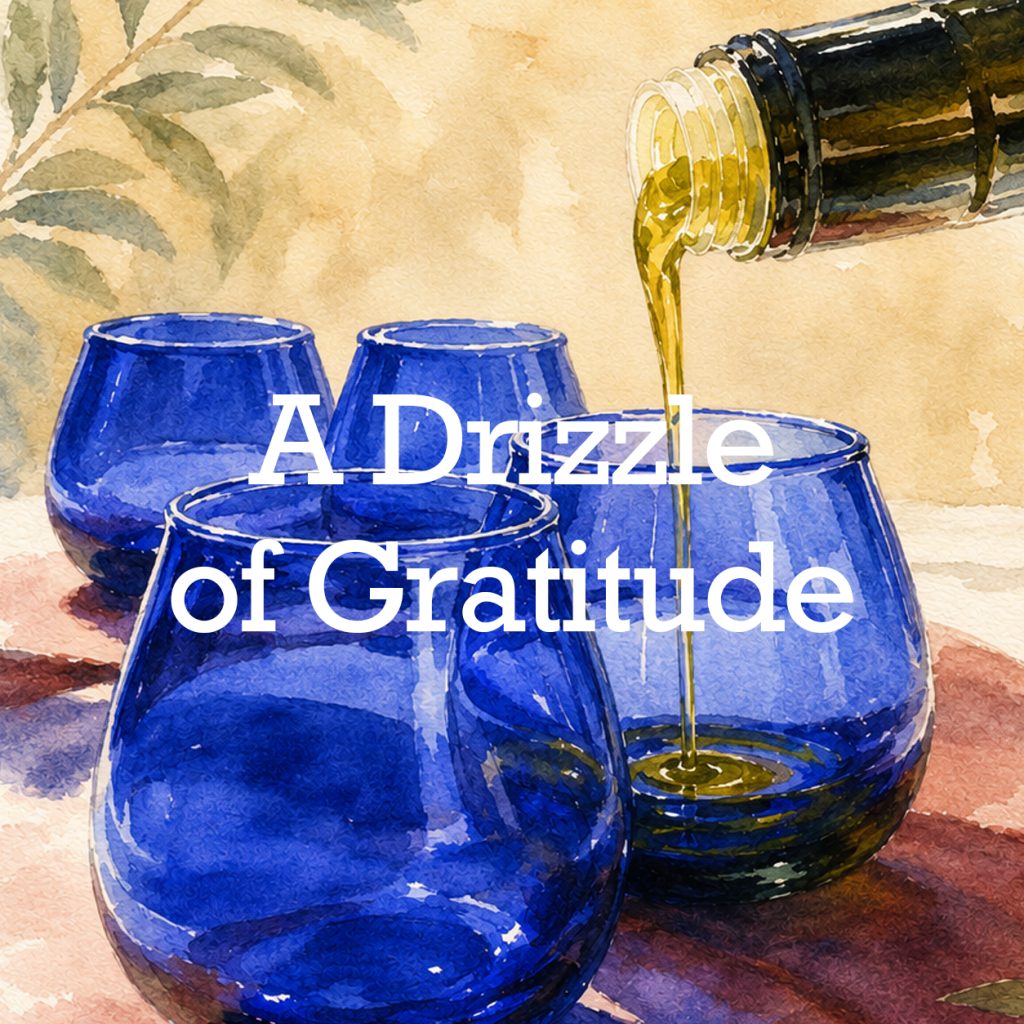
  • A Drizzle of Gratitude

    Every November, we’re reminded to slow down, gather, and give thanks. And while Thanksgiving looks a little different for everyone — big families, small tables, Friendsgiving, beach picnics, or even a quiet dinner for one — the heart of it is always the same:

    we show love by feeding each other.

    In the olive oil world, we talk constantly about health, polyphenols, flavor profiles, harvest seasons, and regions — and yes, all of that matters. But lately I’ve been thinking about something simpler:

    ✨ Olive oil is really an act of generosity.
    We press a fruit, bottle the best of it, and share it — not because we have to eat, but because we want the people we love to enjoy something beautiful.

    Maybe that’s why drizzling olive oil over warm bread or tossing a salad for the table feels so much like a love language.

    This Thanksgiving, I’m grateful for:
    • the comfort of meals shared with the people who make life sweeter
    • the magic of recipes passed down, rewritten, and reinvented
    • the familiar clink of dishes, laughter in the kitchen, and “just a little more”
    • farmers and producers who pour their hearts into every harvest
    • and you — the community that reminds me every day why food matters

    No matter what you’re serving this week — turkey, tofurkey, lasagna, oysters, or takeout (no judgment here!) — I hope your table is filled with warmth, connection, and something delicious.

    And if a beautiful drizzle of olive oil happens to make its way across your plate?
    Even better. 💛

    Happy Thanksgiving from my table to yours.

    — Suzanne, The Olive Oil Gal

  • Pungency: The Bold One in the Room

    If fruitiness is the soul of olive oil, and bitterness its backbone, then pungency is the spark—the wild card, the unexpected friend who barges in with boldness and refuses to be ignored.

    Pungency shows up as that peppery kick in the back of your throat, the fiery tickle that makes you cough once, twice, maybe even three times. Tasters call them “one-cough, two-cough, three-cough oils,” and they’re a badge of honor, proof that the oil is fresh, vibrant, and brimming with health-giving polyphenols.

    At first, pungency can feel like too much. It’s intense, abrupt, even overwhelming—like meeting someone new who speaks a little too loudly or laughs a little too hard. But give it a chance, and suddenly you realize: this is the spark you didn’t know you needed. The one who wakes you up, brings energy to the room, and makes the experience unforgettable.

    Without pungency, olive oil would be flat, missing its fire. With it, the oil feels alive—balanced, bold, and complete. That cough isn’t a flaw; it’s a feature. It’s nature’s way of saying: this oil is working, this oil is real.

    In life, too, pungency teaches us that first impressions aren’t always the final story. Sometimes the things—or people—that challenge us at the start end up becoming the ones we value most. The spark becomes the anchor, the jolt becomes the joy.

    So the next time an olive oil makes you cough, don’t shy away. Smile, and welcome it. That fiery finish isn’t just flavor—it’s friendship. It’s the reminder that what startles us today may one day become the part of life we can’t imagine living without.

    Suzanne, The Olive Oil Gal

  • Bitterness, Reconsidered

    We spend so much of life avoiding bitterness. In food, in memories, in relationships—we equate bitter with unpleasant, something to be pushed aside. But in the world of olive oil, bitterness is not something to fear. It’s something to savor, even to learn from.

    Olives are born bitter. You can’t pluck one off the tree and eat it—it will make you pucker and spit. Yet from that bitterness comes one of the world’s greatest gifts: extra virgin olive oil. Pressed and pure, it carries with it a depth of flavor that is proof of its vitality.

    That sharp, green, almost biting taste on your tongue? It’s the polyphenols—the antioxidants that protect both the fruit and us. They are nature’s signpost of strength. The more bitter the oil, the more alive it is, the more protective it becomes.

    I often think of bitterness as a teacher. Just as oil without bitterness tastes flat, life without its own difficult edges would be shallow. It is often the moments we resist—the sharp conversations, the disappointments, the losses—that end up giving us resilience, balance, and appreciation for sweetness when it comes.

    In an olive oil tasting, I encourage people not to shy away from the bitterness. Instead, lean in. Notice the way it reveals layers of green almond, artichoke leaf, even dandelion greens. Let it linger. Let it open you to complexity.

    Bitterness reminds us that not everything meant for us will feel easy at first. Often, the flavors we resist are the very ones that nourish us most deeply.

    So the next time you taste a bold, bitter oil, remember: it’s more than flavor—it’s a philosophy. Olive oil shows us that bitterness isn’t an ending, but a beginning—the first step toward depth, strength, and balance.

    Suzanne, The Olive Oil Gal

  • Greek chickpea salad with balsamic pickled red onions

    I have a confession: this Greek Chickpea Salad is my absolute favorite. I make it several times a week, and it’s just as perfect for a quick solo lunch as it is for sharing at the table. Simple, vibrant, and endlessly satisfying, it’s also one of the biggest crowd-pleasers at my Mediterranean diet classes.

    Chickpeas—like most beans—are true superfoods. They’re packed with protein and fiber, and they support everything from blood sugar balance to cholesterol management to inflammation. When you pair them with a high-quality extra virgin olive oil, the benefits multiply—delicious proof that healthy food can be full of flavor and joy.

    This salad brings it all together: creamy chickpeas, crisp vegetables, briny feta, and the bright lift of balsamic-pickled red onions. It’s fresh, colorful, and deeply nourishing—Mediterranean eating at its best.

    DRESSING

    SALAD

    • 3 cups chickpeas, drained and rinsed
    • 2 cups mixed yellow and red grape tomatoes, halved
    • ½ English cucumber, diced
    • ½ cup White Balsamic Pickled Red Onions
    • ½ cup kalamata olives, pitted and halved
    • 1/2 cup crumbled feta
    • ½ cup chopped fresh parsley
    • ¼ cup chopped fresh dill
    • ¼ cup chopped fresh mint, plus whole mint leaves for garnish

    In a large bowl, whisk together the olive oil, balsamic, lemon juice, garlic, mustard, salt, and several grinds of pepper.

    Add the chickpeas, tomatoes, cucumber, pickled onions, feta and olives and toss to coat. Toss in the parsley, dill, and mint.

    Season to taste, garnish with fresh mint leaves, and serve.

    Delicious with orzo, quinoa or couscous.

    BALSAMIC PICKLED ONIONS

    • 1 small red onion
    • 1 cup Premium Gold White Balsamic
    • 1 cup water
    • 1 tablespoons sea salt
    • 1 garlic cloves
    • 1/2 teaspoon peppercorns
    • Thinly slice the onions, then place in a 16-oz. jar.
    • Add the garlic and peppercorns.

    Heat the Premium Gold White Balsamic, water, and salt in a medium saucepan over medium heat. Bring to a quick boil , then let cool and pour over the onions. Set aside to cool to room temperature, then store the onions in the fridge.

    Your pickled onions will be ready to eat once they’re bright pink and tender – about 1 hour for very thinly sliced onions, or overnight for thicker sliced onions. They will keep in the fridge for up to 2 weeks.